
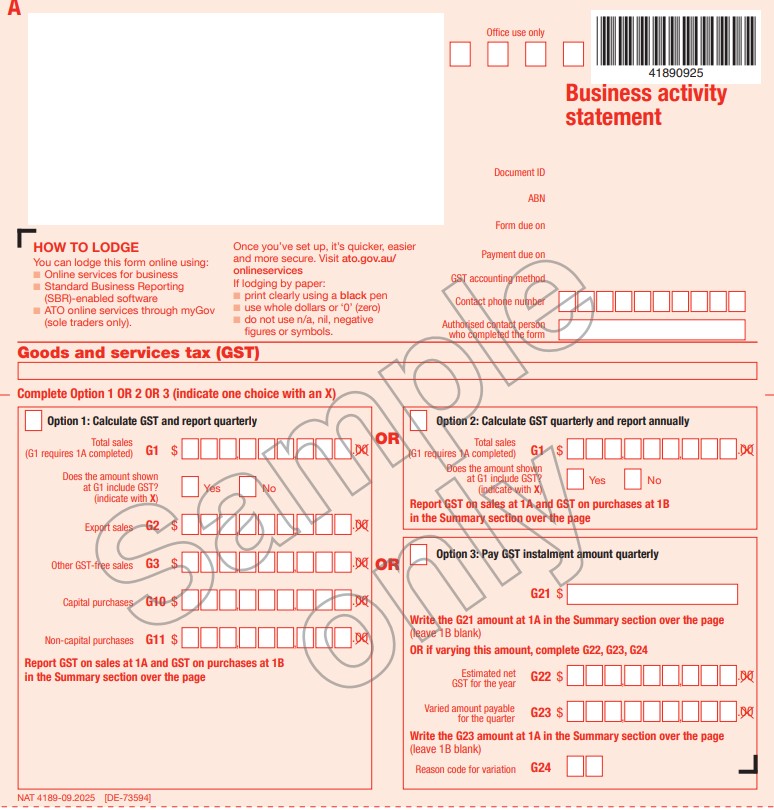
 PAYG withholding
If you have employees (or make payments subject to withholding), this section reports the tax withheld from wages and other payments.
Amounts reported here should reconcile with:
- Payroll records
- STP reporting
- Amounts actually paid to the ATO
 PAYG instalments
PAYG instalments are prepayments towards your expected income tax bill. Not all businesses have this section on their BAS.
Instalments are usually calculated by the ATO based on prior year results, but can be varied if your income changes significantly.
 Common small business BAS mistakes
Some of the most common issues I see include:
- Incorrect GST coding in the accounting software
- Mixing private and business transactions
- Reporting cash vs accrual figures inconsistently
- Forgetting to lodge nil BAS
- Not reconciling BAS figures to reports before lodging
These errors often lead to amended BAS, ATO queries, or unexpected tax bills.
 How good bookkeeping reduces BAS errors
Accurate, up‑to‑date bookkeeping makes BAS preparation far simpler and far less stressful. When your records are clean:
- GST is calculated correctly
- PAYG amounts reconcile
- BAS figures can be checked quickly against reports
- Lodgements are more confident and defensible
This is where having the right systems — and regular reviews — really pays off.
 Final Thoughts
Your BAS isn’t just a form to lodge — it’s a reflection of how well your business records are being maintained behind the scenes. When your systems are set up properly and kept up to date, BAS becomes a routine task rather than a stressful one.
If you’re finding BAS confusing or time‑consuming, it’s usually a sign that something in the process (coding, record keeping, or understanding the requirements) needs tightening up — and that’s something that can be fixed with the right support.
 Last updated: May 2026
 Disclaimer
The information in this article is general in nature and is not intended to be financial or tax advice. Every business situation is different, so you should consider your own circumstances or seek professional advice before relying on this information.